


LYNCH, Arthur.
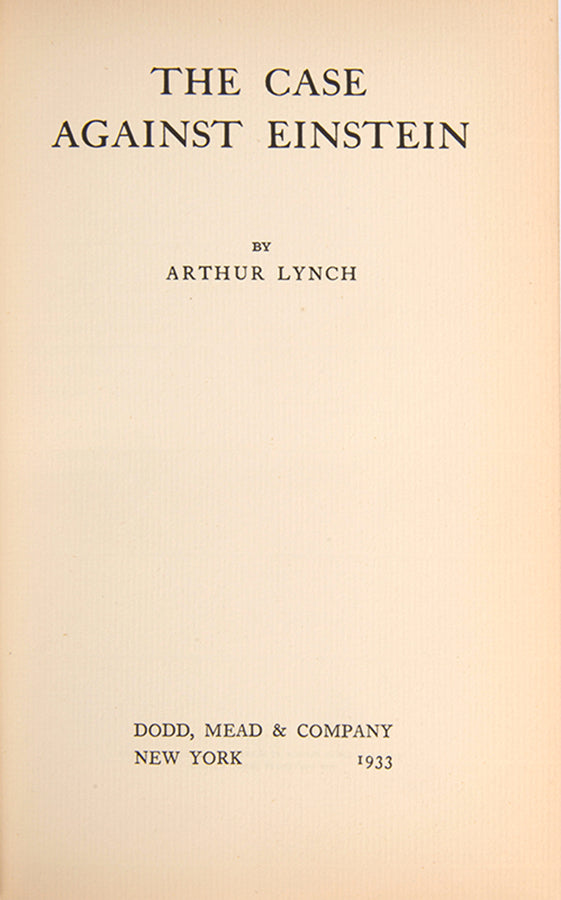
The Case Against Einstein.
The Case Against Einstein.
Stock Code 118180
New York, Dodd, Mead & Company, 1933.
tried for treason
First US edition, first printing of this rare work of amateur physics by a remarkable public figure who was tried and sentenced to death for treason. Originally published by Philip Allan in the UK in 1932. Worldcat locates no Philip Allan copies and only ten copies of the US edition, all in the UK and Europe, and there is also one at the National Library of Australia.Arthur Lynch (1861-1934) was born and raised in Australia, the son of an Irish civil engineer, and followed in his father's footsteps, earning a second-class certificate in that field. His autobiography depicted his younger self as 'a precocious genius performing prodigies of both body and mind, equally enthralled by athletics and the differential calculus' (Oxford Dictionary of National Biography). Lynch soon moved to Europe and studied a variety of subjects, including medicine, before becoming a Fleet street journalist. 'He also composed unreadable Byronic and Keatsian verses, along with withering critiques of his more distinguished contemporaries... Alfred Harmsworth regarded him as "a very able journalist, but… a most unpractical person otherwise" (Redmond MS, 15202)' (ODNB).
Upon marrying an Irish woman Lynch became a committed Irish nationalist, joining the Parnelites and 'dabbling in revolutionary conspiracies, not only in Ireland but also in Britain, America and France' (ODNB). Around 1899 he travelled to the Transvaal, ostensibly as a war correspondent, but immediately joined the Boer side and was invited to command a troop of Afrikaaners of Irish origin. Lynch saw little action but spent great energy publicising 'his own celebrity as a warrior' (ODNB).
When Lynch returned to the UK to stand for Parliament he was immediately charged with high treason, 'prosecuted with judicious but lethal elegance by Sir Edward Carson, sentenced to death, imprisoned for life after commutation, and deprived of his seat (January 1903)... Released on a ticket-of-leave after a year of petitioning and agitation Lynch settled in Paris until pardoned in July 1907' (ODNB). He then returned to Britain and graduated from medical school in London.
'Lynch's subsequent career was divided between general practice and authorship of ever more idiosyncratically ambitious works such as Ethics (1922) and The Case Against Einstein (1932), which Lynch considered his crowning intellectual achievement. It thus surpassed even his Principles of Psychology (1923), which he had deemed 'destined to be a lamp to the feet of men when the British Empire itself is forgotten' (Lynch, 134)... Lynch believed himself to be a genius, greater than almost all the great men against whom he had measured himself in body and mind, and whose defects were painstakingly recorded in his autobiography. For all their charm, wit, colour, and erudition, his writings convey more of the charlatan than the genius' (ODNB).
First US edition, first printing; 8vo; diagrams within the text, small bit of sticker residue to the rear pastedown, contents faintly toned; original red cloth, titles to spine gilt, a very good copy in the jacket in the lightly rubbed jacket that is a little darkened along the spine panel and edges; 275pp.
Couldn't load pickup availability
Provenance
Provenance
Delivery
Delivery
We offer secure and express delivery on all local and international orders of rare books, maps and prints placed through this website.
About us
About us
Shapero Rare Books is an internationally renowned dealer in antiquarian & rare books and works on paper.
Our Bookshop and Gallery can be found in the heart of Mayfair at 94 New Bond Street, where most of our stock is available to view and on public display.
We exhibit at major international art fairs, including TEFAF (Maastricht and New York), Frieze Masters, Art Miami and Masterpiece London, as well as antiquarian & rare book fairs including New York, Paris, London, Los Angeles, San Francisco and Hong Kong.
Ask us a question
Ask us a question



FURTHER READING
View all-

250th Anniversary of the Publication of 'The We...
Celebrating 250 years since the publication of Adam Smith's 'Inquiry into the Nature and Causes of the Wealth of Nations'
Philosophy History & Economics250th Anniversary of the Publication of 'The We...
By Oliver YarwoodCelebrating 250 years since the publication of Adam Smith's 'Inquiry into the Nature and Causes of the Wealth of Nations'
-

Conquering Everest | British Expeditions
A narrative of the successive British expeditions into uncharted Everest territory by the brave Lieutenant-Colonel C. Howard-Bury, Brigadier-General. E.F. Bruce and Lieutenant-Colonel. E.F. Hugh Norton.
Travel & ExplorationConquering Everest | British Expeditions
by Lucinda BoyleA narrative of the successive British expeditions into uncharted Everest territory by the brave Lieutenant-Colonel C. Howard-Bury, Brigadier-General. E.F. Bruce and Lieutenant-Colonel. E.F. Hugh Norton.
-

Saving the Arabian Horse: A Connection Between ...
The two great Arab horse studs were connected by more than just a desire to save the treasured Arab breed. They shared an entrepreneurial spirit, a respect and appreciation for...
Travel & ExplorationSaving the Arabian Horse: A Connection Between ...
The two great Arab horse studs were connected by more than just a desire to save the treasured Arab breed. They shared an entrepreneurial spirit, a respect and appreciation for...


