


KEYNES, John Maynard.
A Tract on Monetary Reform.
A Tract on Monetary Reform.
Stock Code 122511
London, Macmillan and Co., Limited, 1924.
near-fine in the original dustjacket
A near-fine copy in dustjacket of the second printing of Keynes' important work on inter-war monetary policy, which attacked the gold standard as a 'barbaric relic' (p.172)A Tract on Monetary Reform was written during a period of general economic instability in Europe, with the Weimar Republic experiencing a prolonged bout of hyperinflation, and many countries muting a return to the gold standard. The work continues the discussion begun in the Economic Consequences of the Peace on the effect of changes in price levels on the distribution of wealth.
For most of his professional career, Keynes subscribed to the quantity theory of money — that is, that increases in the supply of cash leads to a proportionate rise in prices. The present work developed the case for a managed currency, arguing that the Bank of England had sufficient tools available to achieve stability in prices by adjusting its policies in regards to interest rates and its capacity to manage banking reserves.
'To return to the gold standard would mean giving priority to stability in the exchange rate and the external value of the currency over its internal value and forcing inflation or deflation on the economy if prices rose or fell in other countries. The report of the Cunliffe committee in 1918 in favour of an early return to gold at the pre-war parity, adopted as official policy, belonged to "an extinct and almost forgotten order of ideas" and spelt inevitable deflation and unemployment. Earlier Keynes had proposed pegging to gold at the current (devalued) rate and allowing the rate to appreciate if, as he expected, there was a gradual fall in the price of gold. The Bank of England, through its control over bank rate and the banking system, would seek to maintain price stability and fix buying and selling prices each week at the same time as it fixed bank rate. The exchange rate would then change at intervals, not float freely, as happened later' (ODNB).
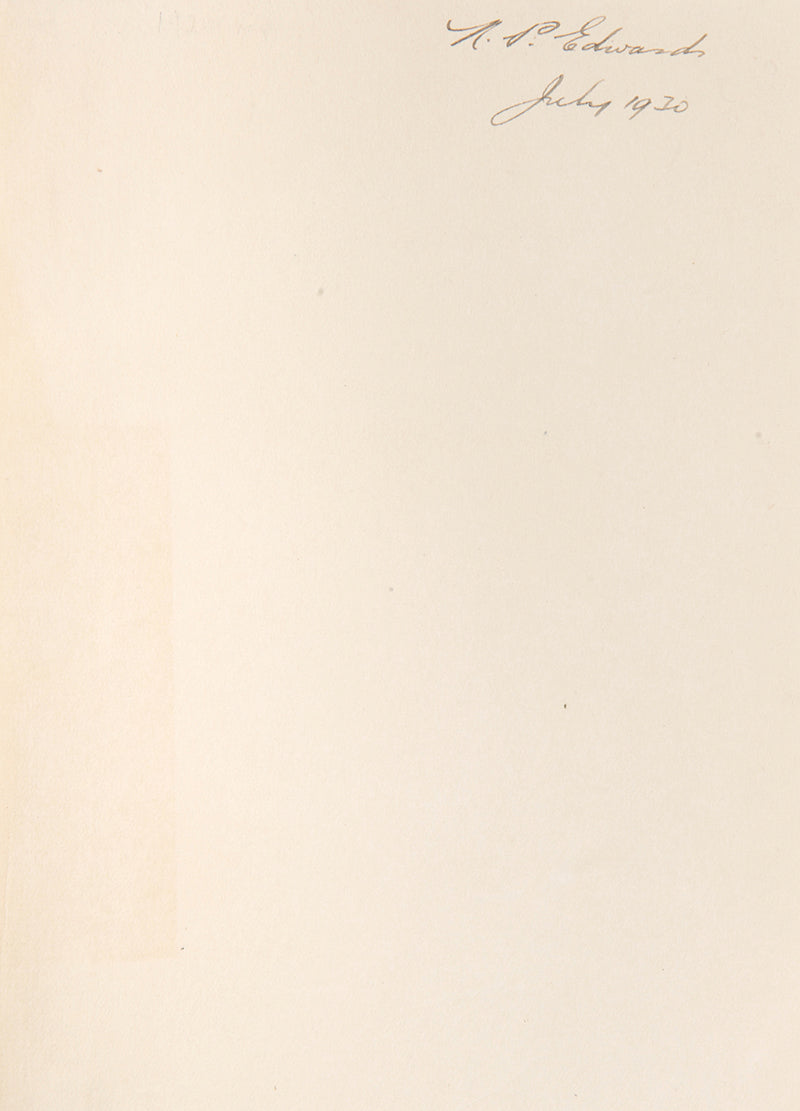
First edition, second printing; 8vo (22 x 14.5 cm); 2pp publisher's ads to rear, ownership inscription in pen to front free endpaper, slight spotting to fore-edge and final few ff, a little offsetting to endpapers; publisher's blue cloth, spine lettered in gilt, very slight wear to extremities, in the original typographic dustjacket printed in blue, spine very slightly darkened, a near fine example; viii,209, [1], 2[ads]pp.
Couldn't load pickup availability
Provenance
Provenance
Delivery
Delivery
We offer secure and express delivery on all local and international orders of rare books, maps and prints placed through this website.
About us
About us
Shapero Rare Books is an internationally renowned dealer in antiquarian & rare books and works on paper.
Our Bookshop and Gallery can be found in the heart of Mayfair at 94 New Bond Street, where most of our stock is available to view and on public display.
We exhibit at major international art fairs, including TEFAF (Maastricht and New York), Frieze Masters, Art Miami and Masterpiece London, as well as antiquarian & rare book fairs including New York, Paris, London, Los Angeles, San Francisco and Hong Kong.
Ask us a question
Ask us a question




FURTHER READING
View all-

Perils of the Sea
When we look at early voyages, we look at what they discovered, but perhaps their greatest achievement was that they completed the voyage at all, and that notable captains such...
Travel & ExplorationPerils of the Sea
Voyages and their CaptainsWhen we look at early voyages, we look at what they discovered, but perhaps their greatest achievement was that they completed the voyage at all, and that notable captains such...
-

Who Creates Our Image of a City?
Award-winning ancient historian Dr Jess Venner takes us through the ‘Views’ of the Folios of Francesco Panini and Jean Barbault.
Travel & ExplorationWho Creates Our Image of a City?
With Dr. Jess Venner, University of Oxford.Award-winning ancient historian Dr Jess Venner takes us through the ‘Views’ of the Folios of Francesco Panini and Jean Barbault.
-

'The Most Perfect Coloured Figure of a Bird'
Discover why Buller’s illustrated work on the unique Aotearoa birds of New Zealand is a rare instance where the second edition is more valuable than the first.
Science & Nature'The Most Perfect Coloured Figure of a Bird'
Buller's Birds of New ZealandDiscover why Buller’s illustrated work on the unique Aotearoa birds of New Zealand is a rare instance where the second edition is more valuable than the first.


