


MARGULIS, Lynn.
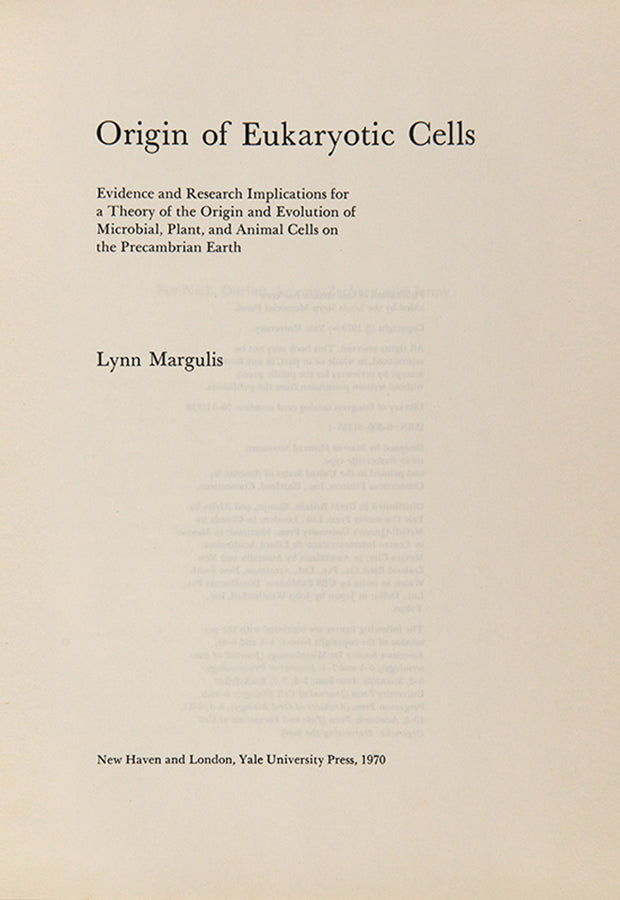
Origin of Eukaryotic Cells.
Origin of Eukaryotic Cells.
Evidence and research implications for a theory of the origin and evolution of microbial, plant, and animal cells on the Precambrian earth.
Stock Code 121240
New Haven, CT and London, Yale University Press, 1970.
a key discovery of 20th century biology
First edition of Lynn Margulis's major monograph on her groundbreaking theory of endosymbiosis. An attractive copy, scarce in such nice condition in the dust jacket.There are two main types of cells, prokaryotic and eukaryotic. 'Prokaryotes, such as bacteria, are very small and have no nucleus or other internal organized bodies. Eukaryotes, on the other hand, such as amoeba, and every cell in our bodies, are much larger and more complicated than prokaryotes, with a nucleus and a vast assortment of internal "organelles", such as ribosomes, mitochondria and (in the case of plants) chloroplasts'. In 1967 the young biologist Lynn Margulis (1938-2011) put forward the idea that eukaryotes evolved by a process of symbiosis, 'whereby one prokaryote took permanent residence inside another, to the mutual benefit of both, gradually (over billions of years) building up more and more complicated cells' (Ashworth, Linda Hall Library, November 2024).
This was extremely controversial at the time, not least because most biologists saw competition, not co-operation, as the driving force in evolution. 'Margulis recounted how the paper was rejected by around 15 leading biology journals before being published in the Journal of Theoretical Biology in 1967. It took more than a decade, however, before she was vindicated. Today it is recognised that mitochondria [the 'powerhouses' of cells] retain traces of their original free-living existence in the form of their own characteristic DNA' (Guardian obituary, December 11, 2011).
First edition; large 8vo; frontispiece, folding plate, and illustrations throughout the text, spotting to endpapers and edges of text block, contemporary ink ownership inscription to the front free endpaper, mark from a small leaf that was previously inserted between the front endpapers; original green cloth, titles to spine in black, a very good copy in the lightly rubbed jacket with some small marks and tanning along the spine panel and edges; 349pp.
Couldn't load pickup availability
Provenance
Provenance
Delivery
Delivery
We offer secure and express delivery on all local and international orders of rare books, maps and prints placed through this website.
About us
About us
Shapero Rare Books is an internationally renowned dealer in antiquarian & rare books and works on paper.
Our Bookshop and Gallery can be found in the heart of Mayfair at 94 New Bond Street, where most of our stock is available to view and on public display.
We exhibit at major international art fairs, including TEFAF (Maastricht and New York), Frieze Masters, Art Miami and Masterpiece London, as well as antiquarian & rare book fairs including New York, Paris, London, Los Angeles, San Francisco and Hong Kong.
Ask us a question
Ask us a question



FURTHER READING
View all-

Travelling Women: Voices that Crossed Borders
Learn the great journeys taken on by woman travellers, including Emily Eden, Gertrude Bell, Ella Sykes, and lady Anna Brassey.
Travel & ExplorationTravelling Women: Voices that Crossed Borders
By Tomos NuttLearn the great journeys taken on by woman travellers, including Emily Eden, Gertrude Bell, Ella Sykes, and lady Anna Brassey.
-

250th Anniversary of the Publication of 'The We...
Celebrating 250 years since the publication of Adam Smith's 'Inquiry into the Nature and Causes of the Wealth of Nations'
Philosophy History & Economics250th Anniversary of the Publication of 'The We...
By Oliver YarwoodCelebrating 250 years since the publication of Adam Smith's 'Inquiry into the Nature and Causes of the Wealth of Nations'
-

Conquering Everest | British Expeditions
A narrative of the successive British expeditions into uncharted Everest territory by the brave Lieutenant-Colonel C. Howard-Bury, Brigadier-General. E.F. Bruce and Lieutenant-Colonel. E.F. Hugh Norton.
Travel & ExplorationConquering Everest | British Expeditions
by Lucinda BoyleA narrative of the successive British expeditions into uncharted Everest territory by the brave Lieutenant-Colonel C. Howard-Bury, Brigadier-General. E.F. Bruce and Lieutenant-Colonel. E.F. Hugh Norton.


