


[ARABIAN HORSES]; BLUNT, Lady Anne; BLUNT, Judith Anne Dorothea; CLARK, Henry Vyvyan Musgrave.
Archive of the Courthouse Farm Stud, the second Arabian Horse Stud in England,
Archive of the Courthouse Farm Stud, the second Arabian Horse Stud in England,
with correspondence from Lady Anne Blunt from both the Sheyk Obeyd and Crabbet Studs.
Stock Code 117871
[1912-2014].
Henry Vyvyan Musgrave Clark (1885-1981) was the first breeder to follow in Lady Anne Blunt's footsteps and set up a Stud dedicated to breeding true Arabian horses following a visit to Crabbet Stud in 1910. He and Lady Anne would keep a warm friendship and business association until her death in 1917, after which Lady Anne's only child Judith Blunt-Lytton, 16th Baroness Wentworth (1873-1957) would run Crabbet for the next 40 years and continue their business relationship. It was Clark who sold Skowronek in 1920 to Lady Wentworth, who would become one of Crabbet's greatest stallions. Clark was also personally interested in the endurance abilities of Arabian horses and himself rode in the late 1910s and early 1920s in several races: part of the archive contains three letters concerning races in America in 1919 including information on the Unites States Mounted Services Cup.
The first batch of letters, from Lady Anne to Clark dated 1912-1917, are full of information on the exchange and purchase of horses such as Refi, Mansur, and Daoud. Along with practical matters, and much encouragement to each other on the success of their respective studs, Lady Anne gives more in depth glimpses into Bedouin culture. In one letter she reveals the breeding choices that formed the current Arabian breeds were often due to a horse '[distinguishing] itself, by which I mean that some mare has performed a remarkable feat in war, at least that is what usually makes a strain fashionable in the desert'. Most of the letters are from the Sheyk Obeyd Stud, the Blunt's stud in Egypt, where Lady Anne lived permanently in her final years. The set of letters between Clark and Lady Wentworth, Anne's daughter, exhibit the continued relationship between Crabbet and Courthouse Farm, despite some differences of professional opinion such as the correct height a pure-blood Arabian should be.
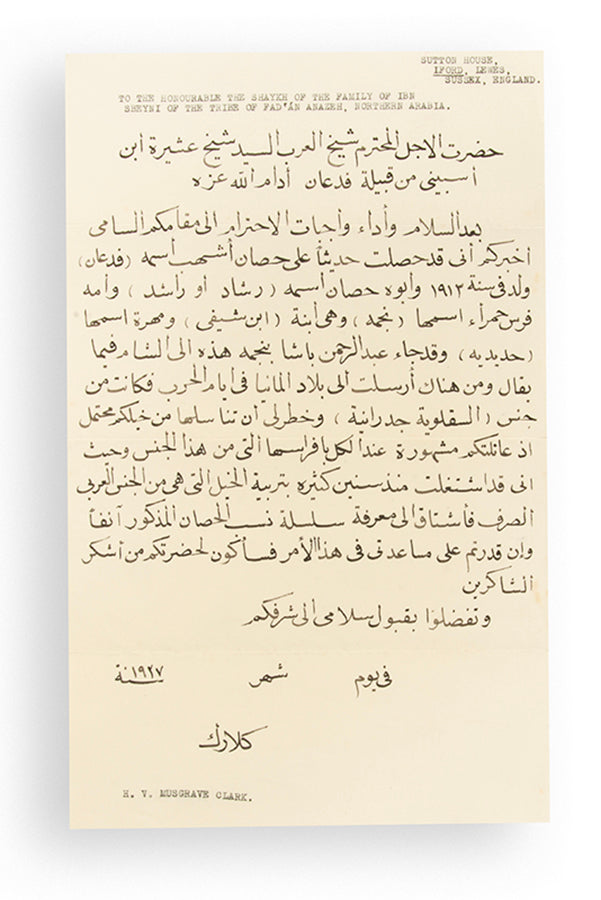
With these letters are two important documents relating to foundational horses whose blood still runs today. The first is the manuscript pedigree of Safarjal (b. 1915) signed by Lady Wentworth and stamped with original wax seal. Safarjal was given as a gift by Lady Wentworth to Clark and the Courthouse Farm Stud in the 1920s and would be an important mare who produced ten foals and whose direct descendants are still breeding in the UK and Germany today. The second document is the certificate of Fedaan, a horse purchased in 1928 by Clark directly from Moudjhem ben Mehed Sheikh of the Feda'an tribe (Ibn Sbenyi) and brokered by the Aleppo British Consul. The certificate is signed by the Consul and accompanied with 12 letters negotiating the sale. Perhaps the most interesting of these is the manuscript copy of the letter written in Arabic which was directly sent to the Feda'an Sheikh and convinced him to sell the horse. Fedaan too was an important stallion with descendants alive today.
The other large collection of letters, numbering more than thirty, are correspondence from leading international Arabian studs and represent the esteemed place of the Courthouse Farm stud in the Arabian breeding community. There are letters from: Spencer Borden, one of the earliest importers of Arab Horses (Crabbet) into America, Edward Skorkowski, the father of the Polish Arab breeding post-WWII, Guilherme Echenique Filho, founder of the first Brazilian Arab stud including his first letter to an English Stud, Carl Reinhard Raswan, one of the great scholars of Arab horses of the 20th century, Lionel Edwards, noted Arab Horse artist, Fortunino Matania, famous WWI and horse artist, Michael Harris, one time director of the Royal Stud of Oman, and more.
Alongside the letters are numerous other documents relating to the Crabbet and Courthouse Studs, including original photographs of 1950s Arabians Ghali, Rahlind, and Ramoth, and 7 photos of the Clarks with various Arabian horses dates 1930s-1950s including Shammaar, original speeches given by Wilfrid Blunt at the Crabbet sales of 1902 and 1913, a letter from the War Office in 1939 confirming the prohibition of drafting Arab horses into the army, a list of the full Sheyk Obeyd Stud in 1917, and numerous ephemera of sales, photocopied correspondence, and research material. In total the collection provides an unrivalled insight into the efforts made by both Henry Clark and Lady Anne Blunt to preserve the original desert Arabians and their esteem for horses that they considered the best in the world.
Full contents list:
19 letters from Lady Anne Blunt to Henry Vyvyan Musgrave Clark 1912-1917.
9 letters from Judith, Lady Wentworth (Anne's only child) continuing correspondence 1921-1955 plus typescript of letter from Mrs Clark to Lady Wentworth.
Pamphlet list of the Sheyk Obeyd Stud printed in 1917.
Original typescripts of two speeches given by Lady Anne's husband the poet Wilfrid Blunt at the Crabbet sales of 1902 and 1913.
Typescript quote of Wilfrid Blunt's which appeared in The Times in 1897
Manuscript pedigree of horse Safarjal (b. 1915) signed by Lady Wentworth with original wax seal.
The certificate of the horse 'Fedaan' purchased by Henry Clark in 1928 from Moudjhem ben Mehed Sheikh of the Feda'an tribes, signed by the Aleppo British Consul, with 12 letters negotiating the sale including the manuscript copy in Arabic of the letter written to the Sheikh from Clark.
The original typescript of the Newmarket Arab Race in 1884 in which 2 horses were entered by the Blunts.
3 letters concerning the endurance races in America in 1919 including the United States Mounted Services Cup.
1 of just 3 copies of the letter from the War Office confirming that no Arab horses should be drafted into the army, 1939.
30+ letters between the Courthouse Stud and the leading international Arab breeders of the day 1913-1990s, including: Spencer Borden, one of the earliest importers of Arab Horses (Crabbet) into America, Edward Skorkowski, the father of the Polish Arab breeding post-WWII, Guilherme Echenique Filho, first Brazilian Arab stud including his first letter to an English Stud, Carl Reinhard Raswan, one of the great scholars of Arab horses of the 20th century, Lionel Edwards, noted Arab Horse artist, Fortunino Matania, famous WWI and horse artist, Michael Harris, one time director of the Royal Stud of Oman.
Manuscript list of the Courthouse Stud 1967-1973.
Photos of 1950s Arabians Ghali and Rahlind, photo of Ramoth, and 7 photos of the Clarks with various Arabian horses dates 1930s-1950s including 'Shammaar'.
1981 issue of the Anglo-Arab Trade Magazine which mentions the Courthouse Stud and the purchase of Fadaan.
Several brochures advertising Courthouse Stud sales of the 1980s including horses Maard and Ansah Ibn Sudan.
Collection of newspaper clippings concerning Judith Blunt from the 1920-1930s, and collection from 1970-1990s concerning Courthouse Stud.
Presentation copy of 'Lady Anne Blunt: Journals and Correspondence 1878-1917' by Rosemary Archer and James Fleming, 1986, with slip.
Numerous photocopied correspondence and research material.
In total over 100 items including: approx. 70 manuscript & typescript letters 1912-1990s, 2 typescript speeches, manuscript pedigree of Crabbet horse with original wax seal, typescript certificate of horse purchase from the Feda'an Sheikh in 1928, printed list of the Sheyk Obeyd Stud from 1917, typescript of the Newmarket Arab Race in 1884, rare 1939 war office letter concerning Arab horses, 10 photos of Courthouse Arabian horses 1930-50s, 1981 issue of the Anglo-Arab Trade Magazine, several 1980s Arab horse sales brochures, presentation copy of 1986 work on Lady Anne Blunt, collection of newspaper clippings, and numerous photocopied and printed correspondence and research; a few letters frayed with one fragile, all else in well-preserved and handsome condition.
Couldn't load pickup availability
Provenance
Provenance
Delivery
Delivery
We offer secure and express delivery on all local and international orders of rare books, maps and prints placed through this website.
About us
About us
Shapero Rare Books is an internationally renowned dealer in antiquarian & rare books and works on paper.
Our Bookshop and Gallery can be found in the heart of Mayfair at 94 New Bond Street, where most of our stock is available to view and on public display.
We exhibit at major international art fairs, including TEFAF (Maastricht and New York), Frieze Masters, Art Miami and Masterpiece London, as well as antiquarian & rare book fairs including New York, Paris, London, Los Angeles, San Francisco and Hong Kong.
Ask us a question
Ask us a question




FURTHER READING
View all-

Travelling Women: Voices that Crossed Borders
Learn the great journeys taken on by woman travellers, including Emily Eden, Gertrude Bell, Ella Sykes, and lady Anna Brassey.
Travel & ExplorationTravelling Women: Voices that Crossed Borders
By Tomos NuttLearn the great journeys taken on by woman travellers, including Emily Eden, Gertrude Bell, Ella Sykes, and lady Anna Brassey.
-

250th Anniversary of the Publication of 'The We...
Celebrating 250 years since the publication of Adam Smith's 'Inquiry into the Nature and Causes of the Wealth of Nations'
Philosophy History & Economics250th Anniversary of the Publication of 'The We...
By Oliver YarwoodCelebrating 250 years since the publication of Adam Smith's 'Inquiry into the Nature and Causes of the Wealth of Nations'
-

Conquering Everest | British Expeditions
A narrative of the successive British expeditions into uncharted Everest territory by the brave Lieutenant-Colonel C. Howard-Bury, Brigadier-General. E.F. Bruce and Lieutenant-Colonel. E.F. Hugh Norton.
Travel & ExplorationConquering Everest | British Expeditions
by Lucinda BoyleA narrative of the successive British expeditions into uncharted Everest territory by the brave Lieutenant-Colonel C. Howard-Bury, Brigadier-General. E.F. Bruce and Lieutenant-Colonel. E.F. Hugh Norton.


