


[VULGATE BIBLE.
In Latin, illuminated manuscript on parchment,
In Latin, illuminated manuscript on parchment,
Stock Code 124923
England, c.1260-1275].
10 illuminated initials
Small portable Bibles containing the complete Old and New Testaments were one of the greatest achievements of 13th-century book production, transforming the use and ownership of the Bible. This English example was copied by numerous scribes, and decorated in a number of styles. The ten handsome illuminated initials decorate the Minor Prophets, an unusual choice. Textual evidence links it to both the Dominicans and Franciscans. Notable here are the numerous additions that show how this was used, including the contemporary table of introits and Mass lections, and numerous marginal notes from the thirteenth to the fifteenth centuries.The first portable Bibles may have been copied in Paris at the end of the 1220s or early 1230s. Many of them were products of the commercial booksellers of Paris. English examples of this type of Bible, however, appear at almost the same time, and 13th-century England was an important centre for the production of Bibles, although in smaller numbers than France. However, the text of English 13th-century Bibles is often quite distinct from contemporary Bibles from Paris. Centralised production in Paris resulted in numerous Bibles that share the same text (the text modern scholars call the Paris Bible). In England, a much more diffuse production meant that there is a much greater variety in the text of the Bibles; there is no 'typical' English text. The Psalms have been omitted here. This is fairly common in 13th-century Bibles, and possibly more common in England than elsewhere.
This Bible does show some influence of the Paris Bible. In particular, the biblical books are arranged according to the 'new' Paris order (the same order used today, with the Gospels followed by the Pauline Epistles rather than by Acts), and the books are divided according to the modern chapters (although as noted above, with many variations, including some that Paul Saenger has identified as English (Saenger, 2013)), and it includes the Interpretation of Hebrew Names.
The many different scribes who copied this book, and the variety of different styles found in the pen decoration, are certainly of great interest. There are many intriguing bits of evidence that tell us how this Bible was put together. The rubricator for example made fairly frequent errors, confusing prologues and biblical books, and in one case, inserting the wrong running title, calling the book usually known as 2 Ezra in 13th-century Bibles, and 3 Ezra by modern scholars (Stegmüller 94,1) 'Osee' (i.e. the minor prophet, Hosea). A corrector changed it to 'iosias' not the usual name for this book, although it does begin 'Et fecit iosias …' The foliation in Roman numerals is also noteworthy (most books in the Middle Ages do not include page or folio numbers) with numerous mistakes in the series, including large gaps, despite the text being complete.
Ten biblical books begin with finely executed illuminated initials by a well-trained, but provincial or idiosyncratic artist, freely interpreting more mainstream initials from commercial centres such as Oxford or Paris; most of the initials are pink or a distinctive mauve shade, with white highlights, infilled with tightly curled vine scrolls that terminate in simple leaves or animal-heads, on contrasting grounds, or on highly polished gold, all heavily edged in black. The 'I' on f. 397v, extends 30-lines, and is infilled with a distinctive geometric lattice-pattern.
The evidence of the script and decorations supports an origin in the second half of the thirteenth century, probably c.1260-1275. It was used very early in its history in England, and many small details fit best with an origin in England, including the lack of a Psalter, the Interpretation of Hebrew Names copied in three columns, variations in the beginnings of some of the chapters (Saenger, 2013, p. 60, n. 104), and the quire structure (especially the quires of sixteen and twenty leaves, Ruzzier, 2013, p. 116). None of these details by themselves would be an argument for an English origin, but together, they are highly suggestive. Moreover, the main style of the penwork decoration, although unusually exuberant, and perhaps idiosyncratic, and the style of the illuminated initials also suggest England. Evidence of the script, however, is more difficult to interpret. There are numerous hands in the volume, and the rounded bookhands used by some of the scribes suggest they may have been from Southern France. It is worth remembering that Aquitaine was English throughout the thirteenth century.
[A full description with further information on the text and the provenance with a full bibliography is available on request.]
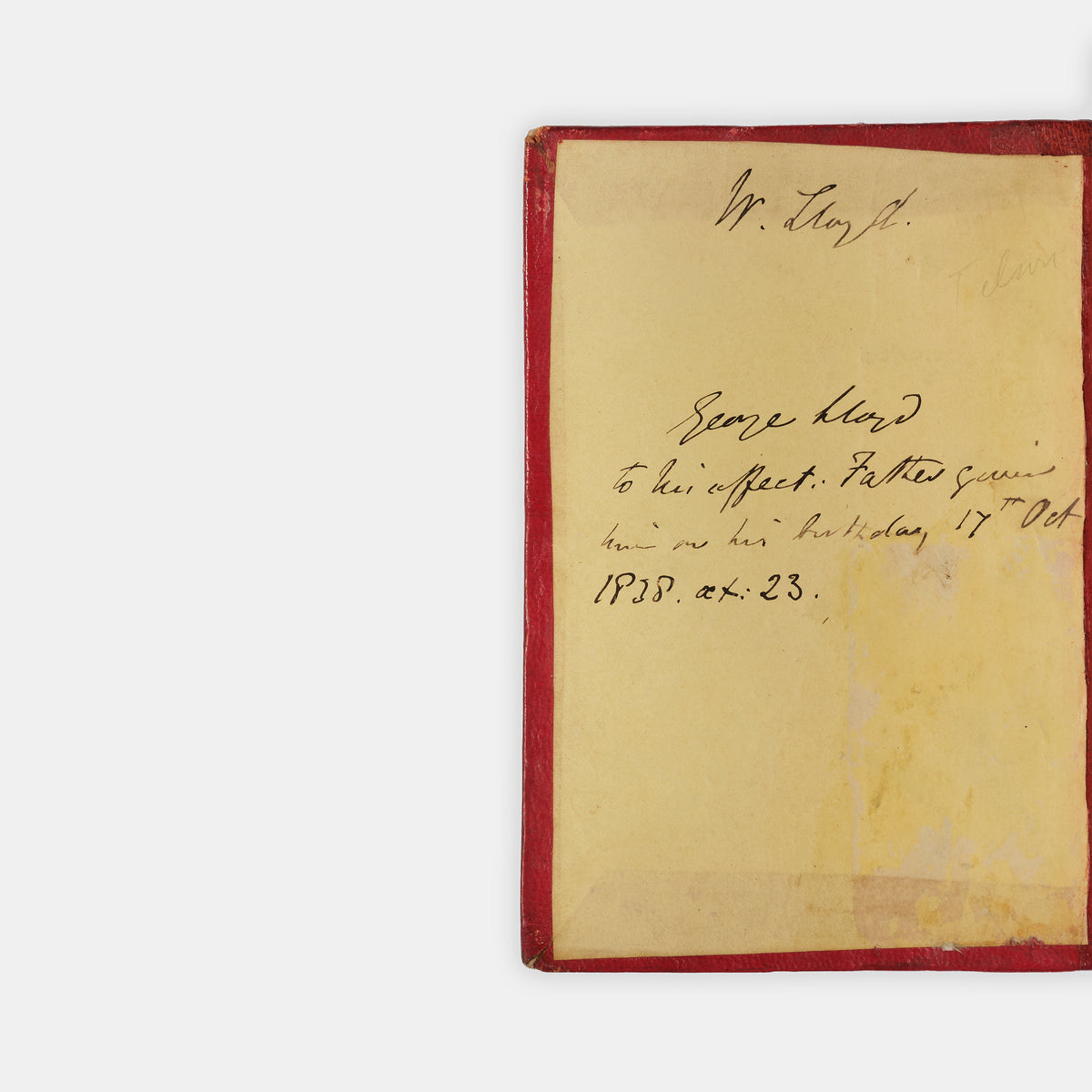
579ll on very thin parchment; early foliation in roman numerals (with errors) top outer corner recto, supplemented by modern foliation in pencil; horizontal catchword centre lower margin in quire 2, traces in quires 12, 16, 18, 19, quires signed at the beginning, very bottom inside corner, in an Arabic numeral, many trimmed (presumably by the 19th-century binder), ruled in lead sometimes with the top two, middle two, and bottom two horizontal lines full across, full-length vertical bounding lines inside, outside, and between the columns, and with an extra set of double rules at the top and bottom of the page (justification 94-90 x 68-64 mm.). Written by many scribes below the top line in very small formal gothic bookhands in two columns (ff. 546-575v, the Interpretation of Hebrew Names in three columns) of 49-45 lines, majuscules within the text stroked with red, red and blue running titles and chapter numbers, occasional red rubrics (often blank spaces for the rubrics remain), one-line alternately red and blue initials, chapters begin with two-line (with extensions up to fifteen lines) alternately red and blue initials with pen decoration in the other colour, approximately sixty-eight 6- to 25-line parted red and blue initials with red and/or blue pen work, parted initials on f. i and iv verso (opening prologue and Genesis) extend the full-length of the page. With ten illuminated initials, 7-lines high, pink or mauve with white highlights, infilled with pink and blue rinceaux, some terminating with animal heads, on highly polished gold grounds, or on contrasting grounds of dark blue or pink, heavily edged in black, overall in very good condition, f. 1 darkened and repaired in the inner margin, f. 32, modern repair with slight loss of text, f. 490, erasure(?) with some damage to a few lines of text, ff. 539-545, damage from damp top outer corner, f. 544, top outer corner repaired (with loss of text), generous margins but trimmed (some loss at the edges of the added text on ff. 544-545), the ink on some pages has faded or been abraded. Bound in early 19th-century red roan, spine elaborately tooled in gilt and lettered 'Biblia/Sacra/M.S.S,' expertly rebacked with old spine laid down, boards with a single gilt rule, speckled edges, with yellow glazed endpapers, lower board and edges lightly scuffed; a very handsome binding, with 20th-century slipcase with paper label to spine lettered in ink and matching chemise. Dimensions 153 x 105 mm.
Branner (Manuscript Painting in Paris during the Reign of St. Louis, 1977); Burke (Heraldic Register, 1850), p. 83; De Hamel (The Book. A History of the Bible, 2001), chapter 5, 'Portable Bibles of the Thirteenth Century'; Light (The Bible and the Individual: The Thirteenth-Century Paris Bible)...
Couldn't load pickup availability
Provenance
Provenance
Delivery
Delivery
We offer secure and express delivery on all local and international orders of rare books, maps and prints placed through this website.
About us
About us
Shapero Rare Books is an internationally renowned dealer in antiquarian & rare books and works on paper.
Our Bookshop and Gallery can be found in the heart of Mayfair at 94 New Bond Street, where most of our stock is available to view and on public display.
We exhibit at major international art fairs, including TEFAF (Maastricht and New York), Frieze Masters, Art Miami and Masterpiece London, as well as antiquarian & rare book fairs including New York, Paris, London, Los Angeles, San Francisco and Hong Kong.
Ask us a question
Ask us a question




FURTHER READING
View all-

Perils of the Sea
When we look at early voyages, we look at what they discovered, but perhaps their greatest achievement was that they completed the voyage at all, and that notable captains such...
Travel & ExplorationPerils of the Sea
Voyages and their CaptainsWhen we look at early voyages, we look at what they discovered, but perhaps their greatest achievement was that they completed the voyage at all, and that notable captains such...
-

Who Creates Our Image of a City?
Award-winning ancient historian Dr Jess Venner takes us through the ‘Views’ of the Folios of Francesco Panini and Jean Barbault.
Travel & ExplorationWho Creates Our Image of a City?
With Dr. Jess Venner, University of Oxford.Award-winning ancient historian Dr Jess Venner takes us through the ‘Views’ of the Folios of Francesco Panini and Jean Barbault.
-

'The Most Perfect Coloured Figure of a Bird'
Discover why Buller’s illustrated work on the unique Aotearoa birds of New Zealand is a rare instance where the second edition is more valuable than the first.
Science & Nature'The Most Perfect Coloured Figure of a Bird'
Buller's Birds of New ZealandDiscover why Buller’s illustrated work on the unique Aotearoa birds of New Zealand is a rare instance where the second edition is more valuable than the first.


